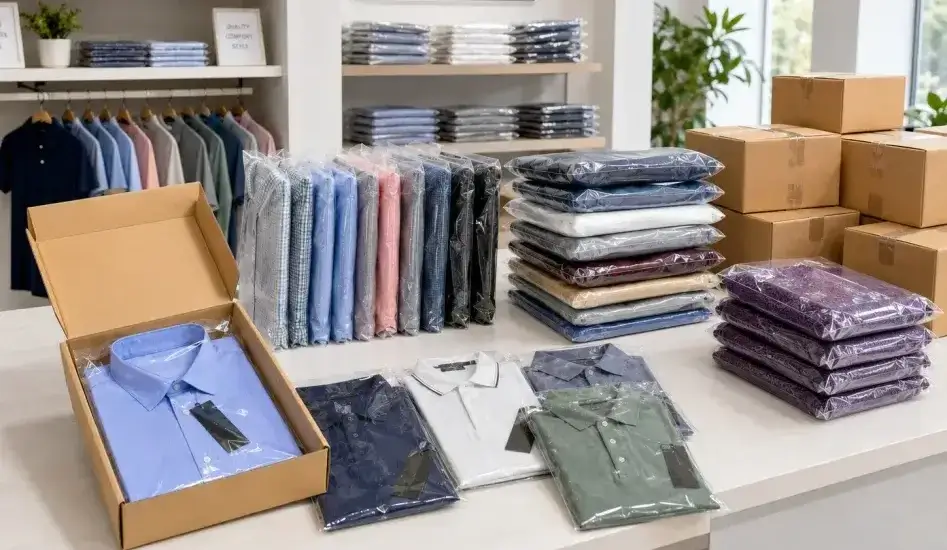
An export house can pass every stitch, seam and shade check and still lose the order. Not on workmanship — on what the air did to the goods between the cutting table and the buyer’s distribution centre.
For garment exporters shipping to the US and EU, humidity has quietly moved from a housekeeping matter to a buyer compliance point. It appears in social and technical audits, it appears in packing specifications, and it appears — expensively — in the form of mould claims and chargebacks when a container is opened at the other end. By that stage the conversation is no longer about air. It is about a debit note, a discounted consignment and a buyer asking why your controls did not catch it.
The uncomfortable part is that the conditions that cause the claim are usually present for weeks before shipment, in plain sight, unmeasured.
Different Floors, Different Numbers
There is no single humidity setting for an export house. Each area has its own band, for its own reason, and the numbers do not overlap neatly.
| Area | Recommended RH | Why |
| Cutting & stitching floor | 55% – 65% | Below 55%: static and needle heating. Above 65%: fabric shrinkage |
| Leather garments section | 45% – 55% | Above 60%: fungus within 48 hours |
| Finished goods / packing | 45% – 60% | Critical for mould prevention |
| Fabric store / warehouse | 50% – 65% | Cotton needs some moisture, or it turns brittle |
| Carton storage & shipment | Below 60% | Containers reach 90% RH in transit — silica is required |
Read across the table and the operating problem becomes obvious. Garment moisture control in a single facility means holding five different bands at once, in a building where doors open, seasons change and the monsoon arrives on schedule. Most export houses manage this by not managing it at all — the floor runs at whatever the weather delivers, and quality absorbs the consequences.
The Cutting and Stitching Floor: Squeezed From Both Sides
At 55–65% RH, the sewing floor sits in a band with a penalty at each edge.
Too dry, below 55%, and static builds in the fabric. Panels cling, lint attaches, handling slows, and needle heating increases — with the fabric damage, thread breakage and needle-hole marks that follow. Too damp, above 65%, and fabric shrinkage enters the process: panels cut to spec no longer measure to spec, and the variance shows up at final measurement audit rather than at the cutting table where it was created.
Neither failure announces itself as a humidity problem. One is logged as a machine or thread issue; the other as a pattern or shrinkage issue. Both are environmental.
The Leather Garments Section: The Tightest Band in the Building
Leather and suede sit at 45–55% RH — narrower than any other area, and for good reason. Above 60% RH, fungus can appear on leather within 48 hours.
Two days. That is shorter than most inspection cycles, shorter than a long weekend, and considerably shorter than the time a finished leather garment typically waits before packing. A single humid spell across a shutdown is enough to produce growth that was not there on Friday.
What makes this section particularly exposed is that it usually sits inside a building conditioned — if at all — for the general sewing floor at 55–65%. That is comfortable for cotton and dangerous for leather. The leather section needs its own band, which in practice means its own controlled environment, not a corner of a larger hall.
Finished Goods, Packing and the Container Problem
Finished goods and packing areas should be held between 45% and 60% RH. This is the last point at which you control anything.
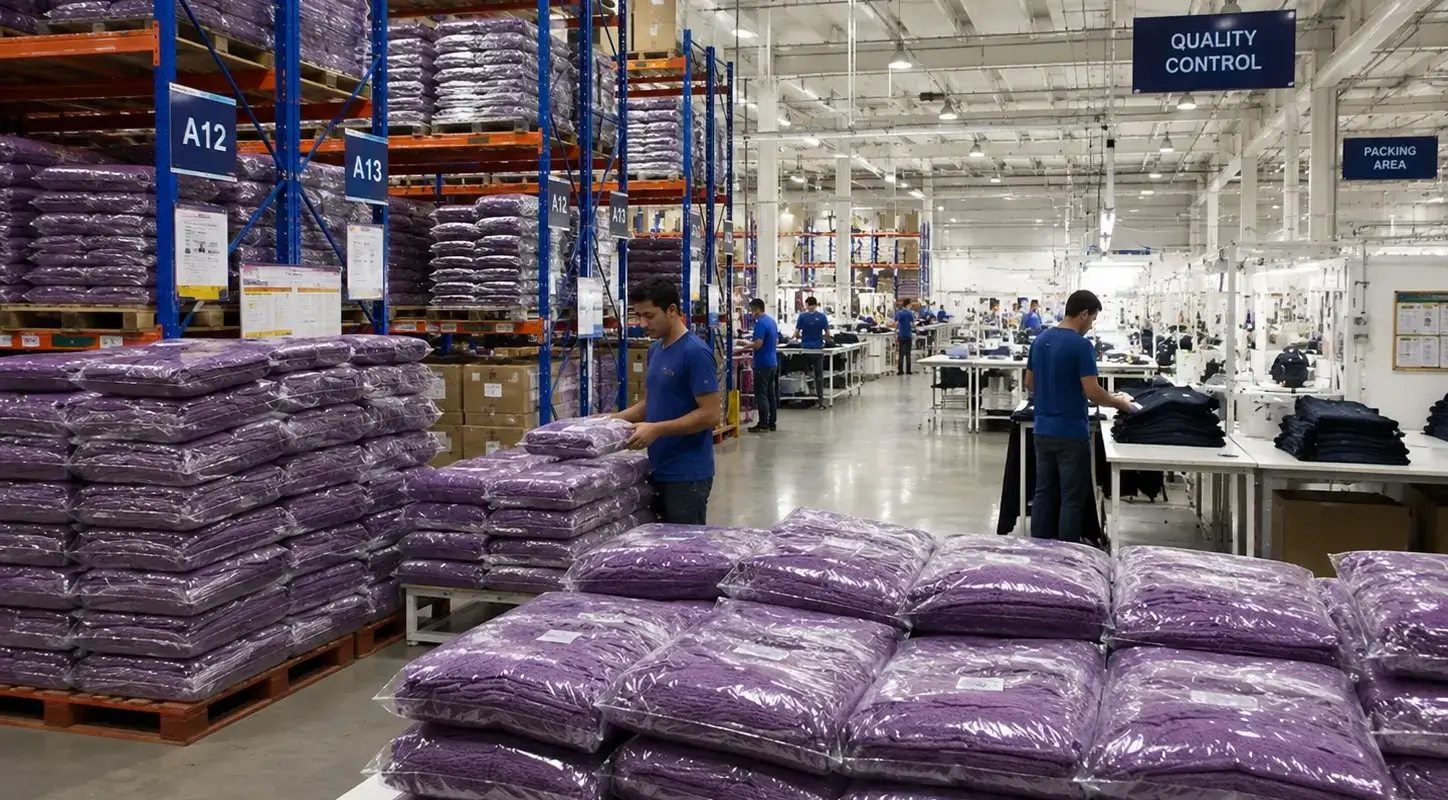
Once the cartons are sealed and loaded, the environment stops being yours. Shipping containers routinely reach 90% RH in transit as temperature swings drive condensation inside a closed steel box, and silica desiccant is used inside the packaging to absorb it. But silica has a finite capacity, and it does not distinguish between moisture that entered in transit and moisture that was already sealed into the carton at your packing station.
That is the point most exporters miss. Goods packed at 70% RH arrive carrying their own moisture load. The desiccant is consumed defending against moisture you shipped, not moisture the ocean added — and by discharge, the margin is gone. Packing dry is not an alternative to in-carton desiccant; it is what makes the desiccant sufficient.
The Fabric Store: Where Drier Is Not Better
Fabric warehouses run at 50–65% RH, and this is the area where the instinct to dehumidify aggressively does real damage. Cotton needs some moisture in it. Strip that out and the fibre becomes brittle, with consequences that carry straight through to the cutting floor and the finished garment.
The objective in the fabric store is stability inside a band, not minimum humidity. A store that swings between 40% and 80% across a season is a worse store than one that holds 60% all year.
Why the Factory Air Handling You Already Have Will Not Hold These Bands
Most export houses already run air conditioning, air washers or evaporative cooling across the floors. None of these control humidity in the way the table above requires.
Air conditioning removes heat; the moisture it takes out is a by-product of the cooling cycle, governed by cooling load, coil temperature and airflow rather than by how damp the building actually is. Evaporative cooling and air washers do the opposite — they lower temperature by adding moisture to the air, which is precisely the wrong direction for a packing hall or a leather section during the monsoon.
The result is a facility that tracks the weather. Through the monsoon, floors sit well above 65% and the leather section sits above 60% for days at a time. Through winter, heated and dry conditions push the sewing floor under 55% and static returns. In neither case is anyone controlling anything; the seasons are.
Desiccant Dehumidification: Holding a Band, Independently of Temperature
A desiccant dehumidifier for the garment industry removes moisture directly rather than waiting for a cooling cycle. Process air passes through a rotating desiccant rotor that adsorbs water vapour out of the airstream; a separate heated reactivation airstream passes through another segment of the same rotor, driving the collected moisture off and exhausting it outside the building. The rotor turns continuously between the two, so moisture removal is steady and predictable — and unaffected by how hard the cooling system happens to be working.
For an export house, this is what makes zone-wise control possible: the leather section at 45–55%, the packing hall at 45–60% and the sewing floor at 55–65%, held through a monsoon, on the same setpoints used in February.
Bry-Air has been engineering desiccant dehumidification since 1964. In garment facilities, the Bry-Air® Compact (FFB Series) is applied to leather and suede sections, packing rooms and smaller enclosed areas where space is constrained, while the Bry-Air® Industrial (FLi Series) serves larger sewing floors, fabric stores and finished goods warehouses. Selection is based on room volume, air-change rate, envelope leakage and worst-case outside moisture load — not floor area alone.
Turning It Into Something an Auditor Can See
- Zone the building before you specify equipment. Five areas, five bands. A single facility-wide setpoint will fail at least two of them.
- Log, don’t spot-check. Continuous RH and temperature logging per zone, across a full season. A reading taken at 11 a.m. in October tells a buyer nothing about a Tuesday in July.
- Give leather its own envelope. A 45–55% section cannot sit unenclosed inside a 55–65% hall.
- Record RH at packing. Carton-level moisture control starts with the air the carton was sealed in. This is the number that defends you when a claim is raised.
- Alarm both directions. Below-band readings matter as much as above-band ones — static, needle heating and brittle cotton are all dry-side failures.
- Maintain rotors and filters on schedule. Adsorption and filtration performance both degrade with neglect, and degraded performance is invisible until an audit or a claim finds it.
Documented Control Is the Point
A buyer audit does not ask whether your factory felt dry. It asks what band each area is held to, how that is controlled, and what the record shows. An export house that can answer with logged data and dedicated equipment is in a very different position — during the audit, and afterwards when a claim is raised — than one relying on the season to cooperate.
Mould claims and chargebacks are not really moisture events. They are documentation events. The moisture was controllable months earlier, in a building you own, for a fraction of the cost of the debit note.
Need your sewing floor, leather section and packing hall held to different bands through the monsoon? Contact an Airgineer for a zone-wise assessment of your facility and a dehumidifier selection matched to each area.
FAQs
1. Why is garment moisture control important for export houses?
Garment moisture control keeps each area of a facility within its required humidity band across production, storage and packing. For export houses it matters because humidity is a buyer compliance point in US and EU audits, and uncontrolled humidity can lead to mould claims and chargebacks, as well as fabric shrinkage and static.
2. How does humidity affect garments during storage and packing?
In storage and packing, high humidity raises the risk of mould and fungus. On leather, fungus can appear within 48 hours above 60% RH. Overly dry conditions cause problems elsewhere in the facility, such as static on the sewing floor and brittle cotton in fabric stores.
3. What should be considered when selecting a desiccant dehumidifier for the garment industry?
A desiccant dehumidifier for the garment industry should be selected based on room volume, air-change rate, envelope leakage and worst-case outside moisture load, not floor area alone.
4. When is an industrial dehumidifier for garments required?
An industrial dehumidifier for garments is typically needed for larger areas such as sewing floors, fabric stores and finished goods warehouses, where moisture removal must stay steady regardless of the weather. Smaller enclosed areas, such as leather sections and packing rooms, are usually served by compact units.
5. How does zone-wise dehumidification benefit garment export facilities?
Zone-wise dehumidification allows different areas of a garment facility to maintain humidity conditions according to their specific requirements, rather than relying on a single humidity setting for the entire facility.
Recent Posts