Why a 25-year power warranty is decided in the storage room, the layup line and the laminator infeed — long before a module reaches a rooftop
A solar module is sold on a promise that runs 25 years into the future. Almost everything that promise depends on — bond strength, insulation resistance, optical clarity, interconnect integrity — is sealed permanently inside the laminate in a cycle that lasts only a few minutes.
Which is why one of the most consequential variables on a module line is often the one that never appears on a production dashboard: the moisture in the air around the encapsulant before it enters the laminator. This is the core discipline of EVA lamination moisture control.
Once the stack is sealed, trapped moisture cannot be removed by any downstream process. It stays inside the module. And what it does next unfolds slowly, in the field, at the manufacturer’s cost.
Your 25-year power warranty is only as good as the humidity control on your lamination line today.
Why EVA Behaves Like a Sponge
EVA (ethylene-vinyl acetate) is hygroscopic. From the moment a roll is unpacked, it begins taking up moisture from the surrounding air — during staging, cutting, layup and every minute the stack waits before lamination.
This is not a theoretical concern. In a study published in Solar Energy Materials and Solar Cells (Gnocchi, Virtuani, Fairbrother et al., Elsevier, 2023), researchers modelled water pre-absorbed by an uncured EVA roll stored in an uncontrolled environment, or exposed to the daily and seasonal humidity swings typical of a manufacturing plant without dedicated humidity control, and traced its effect on module degradation over a simulated service life.
The finding that matters for a plant head is a simple one: the condition of the air in your storage and assembly areas becomes a permanent property of the module you ship.
What Trapped Moisture Does Inside the Laminate
Moisture that enters the stack before sealing does not stay inert. Under the heat, pressure and vacuum of the lamination cycle — and then over years of thermal and UV stress in the field — it drives several distinct failure mechanisms.
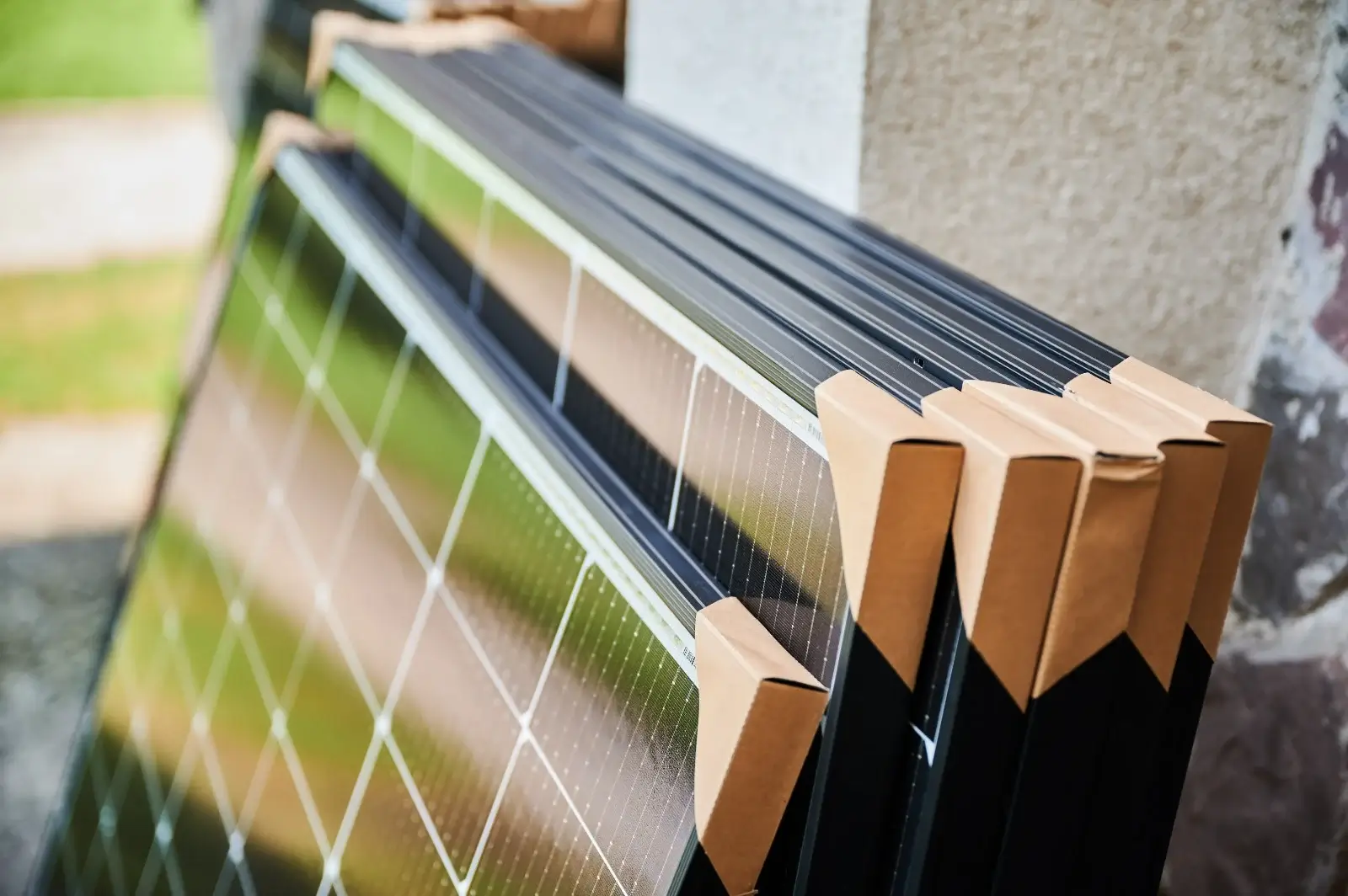
Solar module delamination is one of the key reliability concerns associated with moisture trapped inside the laminate.
- Micro-voids and delamination. At the 140–150 °C of a vacuum lamination cycle, trapped moisture vaporises and forms micro-voids and bubbles, which become initiation points for interfacial delamination at the glass–EVA or cell–backsheet boundary.
- Compromised cross-linking. Moisture present during thermal curing can interfere with the peroxide cross-linking reaction, compromising gel content, bond strength and the elasticity the encapsulant needs to protect cells over decades.
- Acetic acid and metallisation corrosion. Residual water drives EVA hydrolysis, generating acetic acid inside the sealed laminate. That acid attacks front and rear metallisation and ribbon solder joints, contributing to silver migration, snail-trail defects, potential-induced degradation (PID) and measurable power loss.
- Optical loss. Moisture accelerates encapsulant degradation and yellowing, steadily reducing the light reaching the cells and the wattage class the module can hold.
- Electrical safety margin. Moisture lowers insulation resistance and opens leakage-current paths — showing up first as Hi-Pot failures, retesting and dispatch delays, and later as a field safety concern.
The IEA PVPS Task 13 report Review of Failures of Photovoltaic Modules (Report IEA-PVPS T13-01:2014) and its companion Assessment of Photovoltaic Module Failures in the Field (Report IEA-PVPS T13-09:2017) both place delamination, corrosion of interconnects and junction-box failure among the recurring field failure modes in fielded PV modules.
Where Humidity Control Actually Matters on the Line
Humidity does not need to be controlled everywhere in a module plant. It needs to be controlled precisely where the stack is still open — and where moisture, once in, becomes permanent.
- Encapsulant and backsheet storage and unpacking. Preventing baseline hygroscopic absorption before the material ever reaches the line. This is where the cheapest humidity control buys the most reliability.
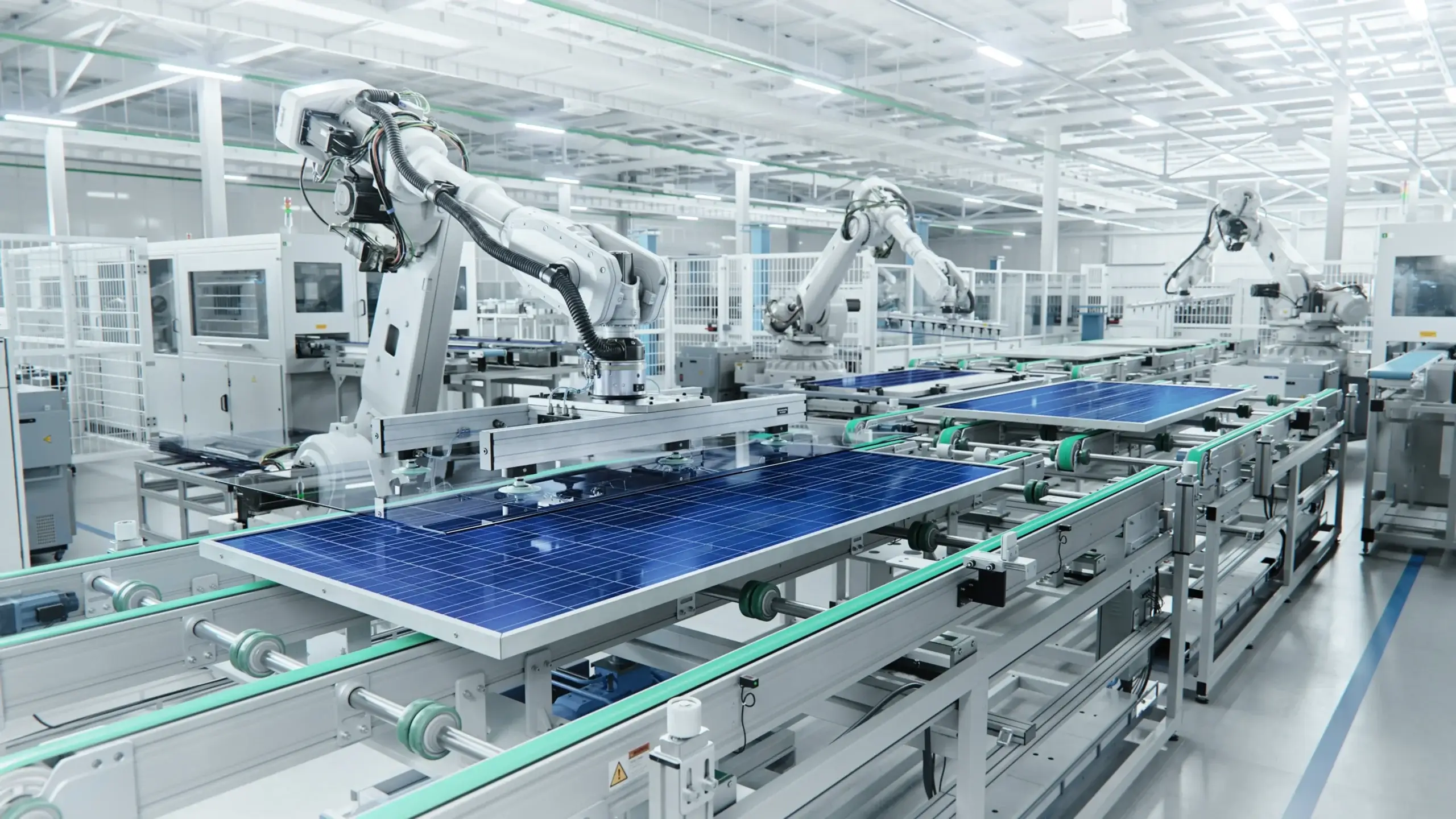
- Stringing, matrix layup and the pre-lamination buffer. Preventing moisture entrapment between layers during assembly. Waiting time here is exposure time — every minute a laid-up stack sits in humid air adds moisture that lamination will seal in.
- Laminator infeed. Ensuring dry conditions right up to the moment of vacuum sealing, so the gains made upstream are not lost in the last few metres of the line.
Two adjacent areas deserve the same discipline: glass preparation, where residual water or condensation directly undermines bonding, and junction-box assembly and curing, where unstable humidity weakens adhesive and potting performance and creates a moisture-ingress path into a finished module.
The Recommended Environment
For EVA storage and the key assembly zones, the working target is a low, stable, year-round condition:
| Parameter | Recommended Condition | Why It Matters |
| Relative humidity | Below 30% RH | Limits hygroscopic uptake by the encapsulant before it is cured and sealed. |
| Temperature | 20–23 °C | Supports stable material handling and consistent film behaviour during cutting and layup. |
| Dew point | Below 4 °C | Keeps glass, cells and ribbon surfaces clear of condensation, including during seasonal and shift-change swings. |
| Zones covered | Storage and unpacking, stringing and matrix layup, pre-lamination buffer, laminator infeed | These four zones form the window in which moisture can still enter the stack. After the vacuum cycle begins, it cannot be removed. |
TOPCon and HJT Raise the Stakes, Not Lower Them
As the industry shifts to n-type architectures — TOPCon and heterojunction (HJT) — many manufacturers are moving to POE (polyolefin elastomer) and EPE co-extruded encapsulant films, partly for their lower water-vapour transmission and better PID resistance.
It would be a mistake to read that as permission to relax the manufacturing environment. Research published in Cell Reports Physical Science (Cell Press, 2023) documents how strongly silicon heterojunction modules react to water ingress, and the IEA PVPS Task 13 report Degradation and Failure Modes in New Photovoltaic Cell and Module Technologies (Report IEA-PVPS T13-30:2025) examines degradation and failure modes specific to TOPCon and heterojunction designs, including potential-induced degradation and encapsulant-related failures.
Changing the encapsulant chemistry does not remove the need for a dry manufacturing environment. For these technologies, moisture control during manufacturing is at least as important as it was for conventional EVA — and arguably more so.
From Utility Cost to Reliability Lever
Dehumidification is often filed under facility overhead. On a module line, it belongs in a different column — alongside first-pass yield, warranty exposure and long-term Solar Module Reliability. A Desiccant Dehumidifier for Solar Panel Manufacturing helps maintain stable process conditions even when outdoor humidity and temperature fluctuate.
The KPIs affected are the ones this industry already tracks:
- A-grade yield, rework and scrap rate, and lamination defect rate
- Peel strength and gel content consistency
- Hi-Pot failure rate and retest frequency
- Damp-heat and PID performance in qualification testing (IEC 61215 series for design qualification and type approval; IEC TS 62804-1 for PID test methods on crystalline silicon modules)
- Warranty claim rate and total cost of poor quality
- Cost per watt
The economics are back-loaded, and that is exactly what makes moisture dangerous. A defect created in a humid layup room may pass visual inspection, EL and flash test without objection. It surfaces years later as delamination, corrosion or power loss — by which point the cost includes replacement modules, logistics, site service, failure investigation, and a customer relationship that is harder to repair than a module.
How Bry-Air Supports Solar Module Manufacturers
Bry-Air has spent decades engineering desiccant dehumidification for manufacturing environments where moisture is a quality parameter rather than a comfort issue — pharmaceuticals, lithium battery dry rooms, electronics, food processing and defence among them. The requirement in a module plant is recognisably the same: a low, stable relative humidity that holds regardless of ambient conditions outside.
That distinction matters in practice. Refrigeration-based systems become progressively less effective as the target humidity drops, and their performance moves with the cooling load and the weather. Desiccant systems hold the set point through monsoon, through coastal humidity, through a night shift in August — which is precisely what a process parameter has to do to be worth calling one.
Typical areas addressed in a module plant include:
- Dry storage rooms for encapsulant, backsheet and moisture-sensitive materials
- Humidity-controlled stringing, layup and pre-lamination buffer zones
- Dry laminator infeed conditions
- Junction-box assembly and curing rooms
- Electrical and Hi-Pot testing areas
- Finished goods storage and packaging zones
Because Performance Begins Before Installation
In an industry where manufacturers increasingly compete on reliability as much as on capacity, the difference between a module that holds its rating and one that quietly loses it is often decided upstream of every test on the line.
Fewer bubbles. Stronger seals. Greater reliability in the field.
The air in your plant becomes part of every module you ship. It is worth engineering deliberately.
Contact an Airgineer to review the humidity-critical zones on your module line and identify where dehumidification will protect yield and long-term reliability.
Frequently Asked Questions
1. Why is a Desiccant Dehumidifier important for solar panel manufacturing?
A Desiccant Dehumidifier for Solar Panel Manufacturing helps maintain controlled humidity in areas where moisture can affect encapsulants, cells, backsheets and other moisture-sensitive materials. Stable humidity conditions can help reduce moisture absorption and support consistent production quality.
2. What is EVA lamination moisture control?
EVA lamination moisture control involves maintaining appropriate humidity and dew-point conditions during EVA storage, handling, layup and the pre-lamination stages. Since EVA can absorb moisture from the surrounding environment, controlling humidity helps minimise the amount of moisture that can become trapped inside the module during lamination.
3. How does moisture contribute to solar module delamination?
Solar module delamination can be associated with moisture entering the module stack before or during lamination. Trapped moisture can contribute to bubbles, voids and weakened interfaces between the glass, EVA, cells and backsheet, potentially affecting the module’s long-term durability.
4. How does a desiccant dehumidifier support Solar Module Reliability?
A Desiccant Dehumidifier for Solar Panel Manufacturing helps maintain stable environmental conditions across moisture-sensitive production areas. By controlling humidity before the module is sealed, manufacturers can help minimise moisture-related risks and support overall Solar Module Reliability.
5. Which areas of solar panel manufacturing require humidity control?
Important areas include EVA and backsheet storage, material unpacking, stringing, matrix layup, pre-lamination buffer areas and laminator infeed zones. Effective EVA lamination moisture control across these stages helps prevent unnecessary moisture exposure before the module stack is permanently sealed.
6. Can humidity control help reduce defects during EVA lamination?
Yes. Maintaining controlled humidity during material handling and assembly can help reduce moisture entering the module stack. Effective EVA lamination moisture control can support consistent lamination quality and help minimise conditions associated with bubbles, voids and solar module delamination.
7. Why is moisture management important for long-term Solar Module Reliability?
Solar Module Reliability depends on several factors, including strong material bonding, insulation performance, optical clarity and resistance to environmental degradation. Maintaining controlled humidity during manufacturing, supported by a suitable Desiccant Dehumidifier for Solar Panel Manufacturing, can help reduce moisture-related risks before the module reaches the field.
Recent Posts