Gas Phase Filtration for Maintaining Low-Corrosivity Environments in Mission-Critical Data Centers
Modern data centers are designed to eliminate single points of failure through redundant power, precision cooling, and resilient network infrastructure. Yet one reliability risk often remains invisible until failures begin to appear: atmospheric corrosion caused by airborne molecular contaminants (AMC).
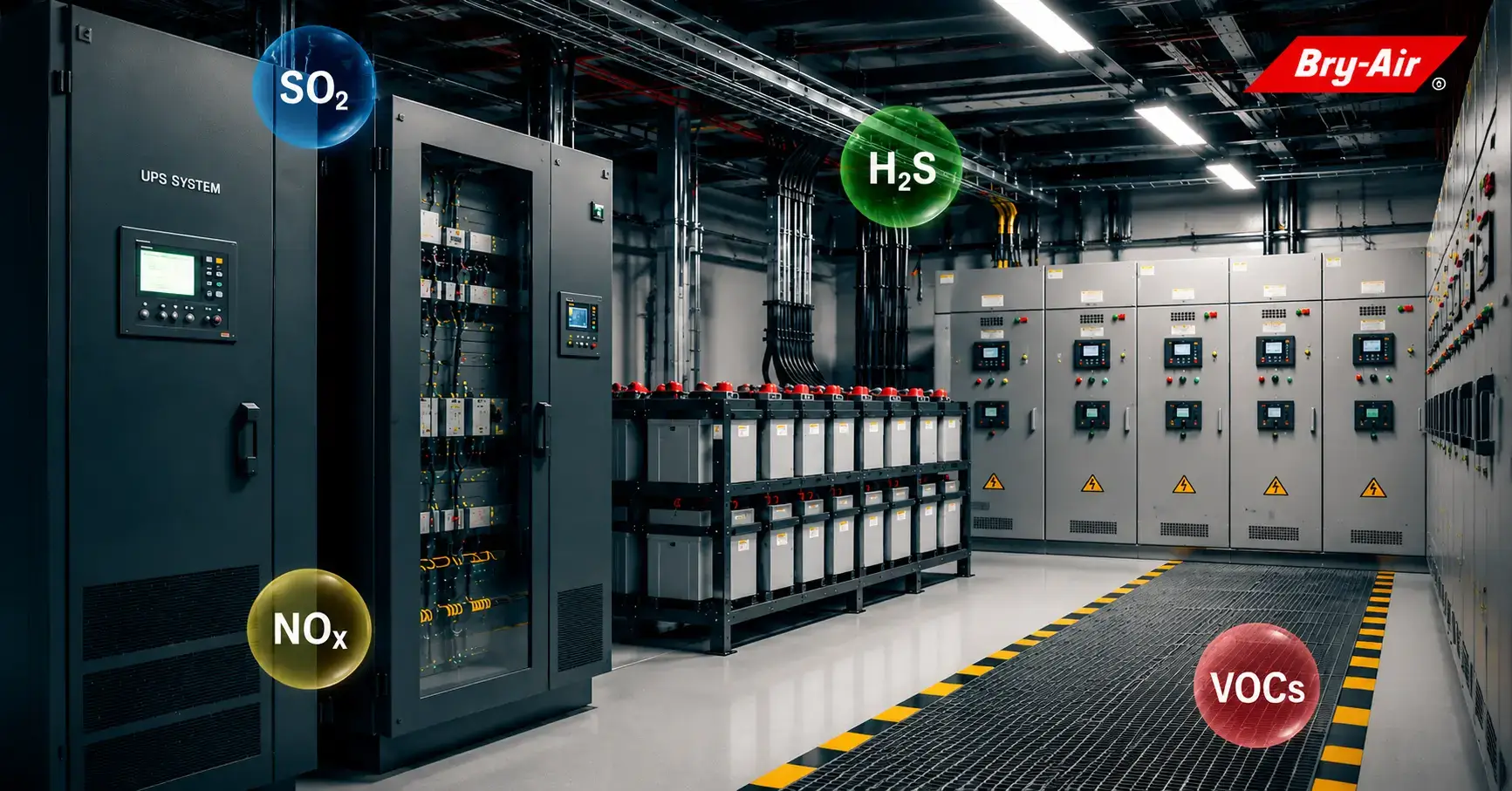
As AI workloads increase rack densities and operators adopt air-side or hybrid economisation strategies to improve energy efficiency, outdoor air can introduce corrosive gases into mission-critical environments. Compounds such as hydrogen sulfide (H₂S), sulfur dioxide (SO₂), nitrogen oxides (NOₓ), ozone (O₃), and chlorine-containing gases react with exposed metallic surfaces on electronic assemblies.
Unlike thermal failures, corrosion develops gradually. It increases electrical resistance, accelerates deterioration of contacts and printed circuit boards, contributes to creep corrosion, and can eventually reduce equipment reliability and service life.
This technical brief explains:
- How corrosive gases affect electronic equipment
- The relevance of ANSI/ISA-71.04 environmental classifications
- Why conventional particulate filtration is insufficient
- How gas phase filtration helps maintain low-corrosivity environments for critical IT infrastructure
1. How Atmospheric Corrosion Affects Data Center Reliability
Data center reliability has traditionally focused on cooling capacity, power redundancy, and fire protection. However, as electronic assemblies become increasingly compact and facilities rely more heavily on outside air for energy efficiency, controlling airborne contaminants has become equally important.
Several industry trends are increasing exposure to corrosive gases.
Higher Equipment Density
Today’s servers, networking equipment, and storage platforms incorporate finer conductor spacing, higher circuit densities, and increasingly compact electronic assemblies. As electronic features become smaller, even minor corrosion on conductive surfaces can affect long-term reliability.
Greater Use of Economization
Air-side economizers reduce cooling energy by introducing filtered outdoor air into the data center. While particulate filters effectively remove dust and aerosols, they are not designed to remove gaseous contaminants such as H₂S, SO₂, NO₂, ozone, or chlorine compounds.
Expanding Deployment Locations
Many modern data centers are constructed near industrial zones, ports, highways, wastewater treatment facilities, petrochemical complexes, or coastal regions where airborne contaminants are naturally higher. Depending on local environmental conditions, these facilities may experience elevated atmospheric corrosivity unless appropriate mitigation measures are implemented.
2. How Corrosive Gases Damage Electronic Equipment
Airborne molecular contaminants react chemically with exposed metallic surfaces throughout the facility—not only within IT equipment but also across electrical and mechanical control systems.
Components commonly affected include:
- Servers
- Network switches
- Storage systems
- UPS equipment
- Rack PDUs
- Power distribution systems
- Building Management Systems (BMS)
- CRAC and CRAH controllers
- Fire detection and suppression control panels
- Generator control systems
- Monitoring and automation equipment
Common failure mechanisms include:
- Increased contact resistance
- Sulfide formation on silver contacts
- Oxidation of copper conductors
- Creep corrosion on printed circuit boards
- Relay malfunction
- Connector degradation
- Intermittent communication faults
These failures rarely occur suddenly. Instead, corrosion gradually reduces equipment reliability, making faults more difficult to diagnose and increasing maintenance costs over time.
3. Measuring Environmental Corrosivity: ANSI/ISA-71.04
ANSI/ISA-71.04-2013 provides an internationally recognized method for classifying atmospheric corrosivity using copper and silver corrosion coupons exposed for 30 days.
| ISA Class | Environment | Copper Reactivity | Silver Reactivity |
| G1 | Mild | <300 Å / 30 days | <200 Å / 30 days |
| G2 | Moderate | <1000 Å / 30 days | <1000 Å / 30 days |
| G3 | Harsh | <2000 Å / 30 days | <2000 Å / 30 days |
| GX | Severe | >2000 Å / 30 days | >2000 Å / 30 days |
ASHRAE TC 9.9 recommends classifying the environment using the higher of the measured copper or silver corrosion rates.
Rather than measuring airborne gases directly, corrosion coupon testing provides an integrated assessment of how the environment affects electronic materials over time.
4. Airborne Molecular Contaminants in Data Centers
Corrosive gases encountered in data centers may originate from external industrial emissions, vehicle traffic, wastewater treatment facilities, nearby manufacturing operations, marine environments, or internal building sources.
Common contaminants include:
| Gas | Typical Sources | Potential Impact |
| Hydrogen Sulfide (H₂S) | Wastewater, refineries, pulp & paper | Silver sulfide formation |
| Sulfur Dioxide (SO₂) | Industrial combustion | Copper oxidation |
| Nitrogen Oxides (NOₓ) | Traffic, power generation | Oxidative corrosion |
| Ozone (O₃) | Outdoor air, electrical equipment | Polymer and metal degradation |
| Chlorine Compounds | Industrial processes, coastal environments | Accelerated corrosion |
The concentration of these gases may remain well below levels that affect human health while still being sufficient to damage sensitive electronics over extended periods.
5. Why Conventional HVAC Filtration Is Not Enough
Standard HVAC filtration is designed primarily for particulate removal.
Filters such as MERV, HEPA, and ULPA effectively capture dust, pollen, fibers, and airborne particles but have little ability to remove gaseous contaminants.
Because corrosive gases exist as individual molecules rather than suspended particles, they pass through conventional filters unless dedicated gas phase filtration media is used.
Maintaining appropriate temperature and relative humidity also reduces certain corrosion mechanisms but does not eliminate airborne molecular contaminants.
6. Gas Phase Filtration: Engineering Control for Corrosive Gases
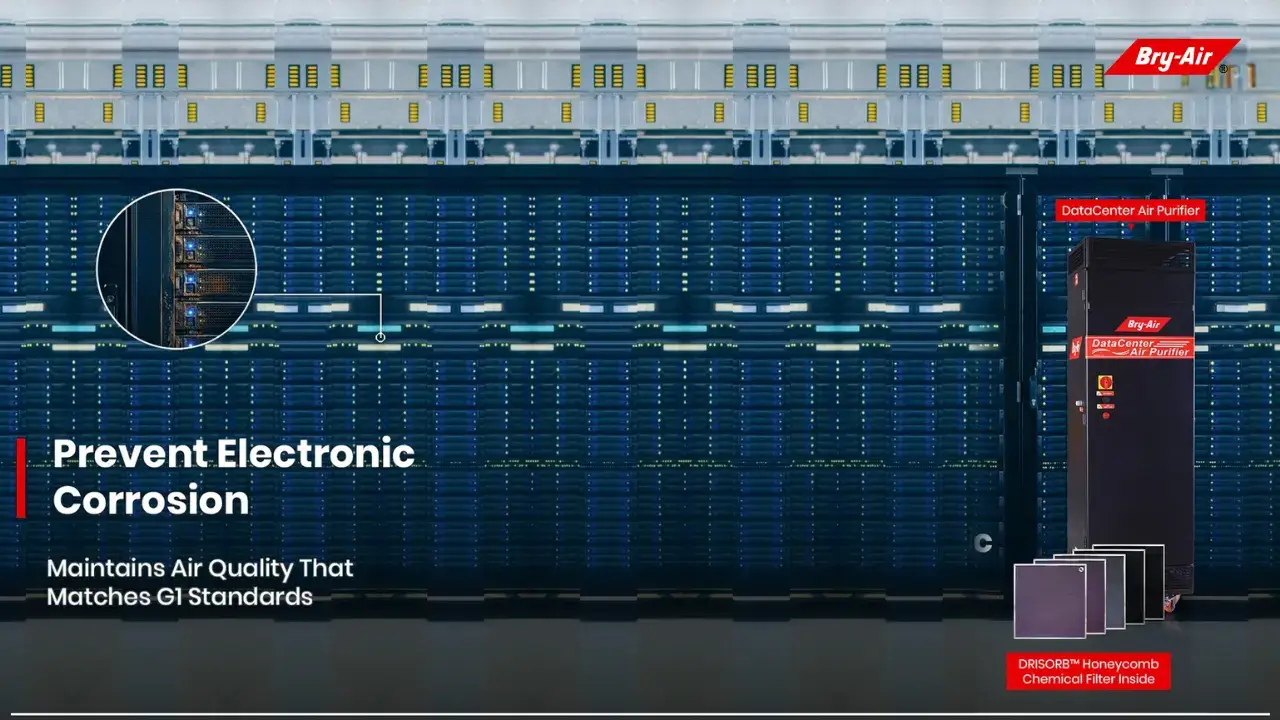
Gas phase filtration removes airborne molecular contaminants through adsorption and chemisorption before they reach sensitive electronic equipment.
Bry-Air DataCenter Air Purifier (DAP) incorporates:
- Multi-stage filtration
- Low-pressure-drop airflow design
- Stainless-steel filter cassettes for simplified maintenance
The system is designed to reduce contaminants including:
- Hydrogen sulfide (H₂S)
- Sulfur dioxide (SO₂)
- Nitrogen dioxide (NO₂)
- Ozone (O₃)
- Chlorine compounds
- Selected organic vapors
Bry-Air chemical filtration media are evaluated in accordance with recognized test methods, including ASHRAE 145.2 and ISO 11155-2, to assess gas removal performance under controlled conditions.
For smaller facilities, edge deployments, and control rooms, BryShield™ provides localized gas phase filtration for protecting electronic equipment where centralized systems may not be practical.
7. Recommended Implementation Strategy
An effective corrosion mitigation program typically follows four stages.
Assess
Conduct an air quality assessment using ANSI/ISA-71.04 copper and silver corrosion coupons to establish the facility’s corrosivity classification.
Classify
Compare measured corrosion rates against ISA environmental classifications to determine whether mitigation is required.
Control
Where elevated corrosivity is identified, implement appropriately designed gas phase filtration on outdoor air intakes and recirculated air streams while maintaining recommended indoor environmental conditions.
Monitor
Periodically repeat corrosion monitoring and replace chemical filtration media according to validated service-life recommendations to maintain long-term performance.
Conclusion
Maintaining reliable environmental conditions requires more than controlling temperature and humidity. Airborne molecular contaminants can gradually compromise electronic equipment long before visible damage or operational failures occur.
For facilities located near industrial, coastal, or urban environments—or those using air-side economization—understanding atmospheric corrosivity is an important part of long-term infrastructure reliability.
Gas phase filtration provides an engineering approach for reducing corrosive gases, helping data center operators maintain low-corrosivity environments consistent with ANSI/ISA-71.04 guidance and supporting the long-term reliability of mission-critical electronic systems.
FAQs – Gas Phase Filtration for Data Centers
How does corrosion affect data center reliability?
Corrosion increases electrical resistance and gradually degrades contacts, connectors, and printed circuit boards. Unlike thermal failures that happen suddenly, corrosion-related damage builds up over time — causing intermittent faults, relay malfunctions, and communication errors that are harder to diagnose and more expensive to maintain as they progress.
What is gas phase filtration?
Gas phase filtration is an engineering control that removes airborne molecular contaminants (AMCs) — such as hydrogen sulfide, sulfur dioxide, nitrogen oxides, ozone, and chlorine compounds — through adsorption and chemisorption, before these gases reach sensitive electronic equipment. Unlike particulate filters, it targets individual gas molecules rather than dust or aerosols.
How can data centers reduce airborne contaminants?
Facilities can install dedicated gas phase filtration systems — such as chemical filtration media in honeycomb configurations — on outdoor air intakes and recirculated air streams. This is especially important for facilities using air-side economization, since standard particulate filters do not remove gaseous contaminants from incoming outdoor air.
Why isn’t standard HVAC filtration enough for data centers?
Standard filters like MERV, HEPA, and ULPA are designed to capture particulates — dust, pollen, fibers — not gases. Corrosive contaminants such as H₂S, SO₂, NOₓ, and ozone exist as individual molecules, so they pass straight through conventional filtration unless dedicated gas phase media is added.
How is data center corrosivity classified?
Corrosivity is classified using the ANSI/ISA-71.04-2013 standard, which exposes copper and silver corrosion coupons for 30 days and measures the reactivity in angstroms. This places the environment into one of four classes — G1 (mild), G2 (moderate), G3 (harsh), or GX (severe) — with ASHRAE TC 9.9 recommending the higher of the two metals’ readings be used for classification.
What is a DataCenter Air Purifier?
A DataCenter Air Purifier (DAP) is a gas phase filtration system purpose-built to protect mission-critical IT environments from corrosive airborne gases. It uses multi-stage filtration with chemical filtration media to remove contaminants before they reach sensitive electronic equipment.
How does the Bry-Air DataCenter Air Purifier work?
It combines multi-stage filtration, honeycomb chemical filtration media, and a low-pressure-drop airflow design to adsorb and chemisorb corrosive gases such as H₂S, SO₂, NO₂, ozone, and chlorine compounds. Stainless-steel filter cassettes are used to simplify ongoing maintenance and media replacement.
Recent Posts