Plastics play an important role in modern automobile manufacturing. From dashboard components and door trims to electrical connectors, sensor housings and under-the-hood parts, automotive plastics support lightweight construction, design flexibility and the functional performance required in today’s vehicles.
Materials such as acrylonitrile butadiene styrene (ABS), polyamide (PA or nylon), polycarbonate (PC), polybutylene terephthalate (PBT) and PC/ABS blends are widely used in automotive applications. However, many of these engineering plastics absorb moisture and require controlled drying before injection moulding.
Automotive plastic drying helps control moisture-related processing defects, protect material properties and maintain repeatable component quality. For manufacturers supplying automotive OEMs and Tier 1 suppliers, this is an important consideration in production reliability and quality management.
Why Is Plastic Drying Important in Automotive Manufacturing?
Many engineering plastics are hygroscopic, meaning they absorb moisture into their polymer structure. Unlike surface moisture, this absorbed moisture cannot always be removed effectively through ordinary hot-air treatment.
When inadequately dried material enters an injection moulding machine, the combination of heat, pressure and moisture can cause processing problems. Depending on the polymer and processing conditions, these may include silver streaks, bubbles, surface blemishes and polymer degradation.
In moisture-sensitive polymers such as polyamide, polycarbonate and PBT, hydrolysis during melt processing can reduce molecular weight and compromise material performance.
The impact depends on the resin grade, moisture level, melt temperature and time spent at processing temperature. Correct drying must therefore be integrated with resin handling and injection moulding process control.
Common Moisture-Related Defects in Automotive Plastic Components
Moisture-related problems can affect component appearance, dimensions and mechanical properties.
1. Silver Streaks and Splay Marks
Silver streaks are visible lines or streak-like marks on the surface of a moulded component. They can occur when moisture or other volatile substances produce gas during processing.
These defects may affect dashboards, decorative trims, visible housings and other components where surface appearance is important.
However, splay marks can also result from material contamination, excessive shear, degradation or incorrect processing conditions. Drying should be investigated alongside these other potential causes.
2. Bubbles and Voids
Residual moisture can vaporize during melting and contribute to gas-related defects. Depending on the component and process, these may appear as bubbles, internal voids or surface irregularities.
Such defects can affect appearance and, where they compromise the component’s structure, functional performance.
3. Reduced Mechanical Properties
Moisture can cause hydrolytic degradation in susceptible polymers during melt processing. This can reduce molecular weight and affect strength, toughness or impact performance.
For automotive components exposed to vibration, temperature changes and mechanical loading, maintaining the resin’s specified properties is essential.
4. Dimensional and Process Variation
Inadequately conditioned resin can contribute to inconsistent moulding behaviour. Combined with variations in melt temperature, cooling, packing pressure and material grade, this can affect dimensional repeatability.
Drying helps stabilize one important input to the moulding process, but dimensional control also requires appropriate mould design and validated processing conditions.
Key Applications of Plastic Drying in the Automobile Industry
1. Automotive Interior Components
Dashboards, door panels, centre consoles, trim parts and decorative components use a variety of thermoplastics, including ABS, PC/ABS and other engineering materials.
These applications may require consistent surface finish, colour, dimensional accuracy and mechanical performance.
Suitable resin drying helps minimize moisture-related defects before injection moulding. This is particularly relevant for visible interior components where cosmetic imperfections can lead to rejection.
2. Automotive Electrical and Electronic Components
Connectors, terminal blocks, sensor housings, switches and electrical enclosures commonly use materials such as PA, PBT, PC and selected high-performance polymers.
These parts may have thin walls, detailed geometries and tight dimensional tolerances. Their reliability depends on the correct material grade, processing conditions and component design.
Controlled drying helps protect moisture-sensitive resins from degradation and supports consistent moulding. For critical electrical applications, material selection and testing remain necessary to verify electrical and mechanical performance.
3. Under-the-Hood Components
Engine-bay and other high-temperature applications may use polyamide, PBT and specialized engineering thermoplastics.
These components can be exposed to heat, vibration, fluids and mechanical stress. Depending on the grade, inadequate drying before melt processing can compromise the polymer’s properties.
Resin-specific drying is therefore an important part of maintaining consistent material performance. Manufacturers should follow the resin supplier’s recommended drying profile and verify that the equipment can achieve it at the required production rate.
4. Exterior Automotive Components
Selected exterior trims, brackets, housings and functional parts are manufactured using ABS, PC blends and other polymers.
Where the resin is hygroscopic, suitable drying can help reduce moisture-related surface defects and support repeatable moulding quality.
The drying requirement depends on the exact material. Not every automotive plastic requires desiccant drying, and the process should not be selected solely on the basis of the component’s application.
5. Precision Injection-Moulded Parts
Automotive suppliers often manufacture parts to defined dimensional, cosmetic and functional specifications.
For these operations, resin moisture is one of the variables that process engineers need to control. A correctly sized drying system helps condition the material before it enters the injection moulding machine.
Consistent drying, suitable machine settings and reliable material handling together help reduce process variation.
Which Automotive Plastics Require Drying?
Different polymers have different moisture absorption characteristics and processing requirements.
| Plastic material | Typical automotive applications | Drying considerations |
| ABS | Interior trim, housings and decorative parts | Commonly requires pre-drying when moisture-sensitive grades exceed the specified moisture limit. |
| Polyamide (PA/nylon) | Connectors, brackets and under-the-hood parts | Hygroscopic; requires controlled drying according to the grade. |
| Polycarbonate (PC) | Housings, selected transparent parts and functional components | Moisture-sensitive; drying helps limit hydrolytic degradation and processing defects. |
| PC/ABS blends | Interior components, instrument-panel parts and housings | Drying requirements depend on the blend formulation and supplier recommendations. |
| PBT | Electrical connectors, sensor housings and functional components | Commonly requires controlled drying before melt processing. |
| PE and PP | Selected trims, liners, ducts and other components | Generally non-hygroscopic; drying is often focused on removing surface moisture when necessary. |
This distinction matters because a single drying strategy is not suitable for every automotive resin. Hygroscopic engineering plastics commonly require desiccant drying, whereas non-hygroscopic materials may need only surface-moisture removal or no drying under suitable handling conditions.
How to Select the Right Drying Parameters for Automotive Plastics
A drying system must be matched to the resin and the demands of the production process.
Drying Temperature
Each polymer grade has a recommended drying-temperature range. Temperatures that are too low may leave residual moisture, while excessive temperatures can cause material degradation, discoloration or other processing problems.
Drying Time and Residence Time
The material must remain under suitable drying conditions long enough to reach the specified moisture level. The required time depends on the resin, pellet characteristics, initial moisture, airflow and equipment design.
Dew Point
The dew point indicates the moisture content of the drying air. Lower dew points generally indicate drier air.
Desiccant dryers are commonly used for moisture-sensitive engineering plastics because they can provide the low-dew-point air required for effective drying. The target should be established according to the resin manufacturer’s instructions.
Airflow and Hopper Conditions
Uniform airflow through the resin bed is essential. Poor airflow distribution, insufficient hopper capacity or excessive material throughput can prevent the resin from reaching the required moisture specification.
Moisture Verification
Process engineers should establish a method to confirm that the resin meets the required moisture limit before processing. Checking the dryer display alone may not demonstrate that the pellets themselves are adequately dried.
The final settings should be validated for the specific resin grade, machine throughput and production conditions.
Desiccant Dryers vs Hot-Air Dryers for Automotive Plastics
The choice between a desiccant dryer and a hot-air dryer depends on the material’s moisture sensitivity and the required drying performance.
Desiccant dryers remove moisture from process air using moisture-adsorbing media. They are commonly used for hygroscopic engineering plastics such as nylon, PC, ABS and PBT where controlled low-dew-point air is required.
Hot-air dryers use heated air to remove surface moisture and condition materials that do not require deep dehumidification. They are generally suitable for non-hygroscopic resins such as PE and PP, subject to the application and material supplier’s requirements.
Using a hot-air dryer where a resin requires low-dew-point drying can leave moisture inside the polymer. Conversely, applying a more complex drying system to every resin may increase equipment and operating costs without delivering a corresponding benefit.
The correct choice begins with material identification and the required final moisture content.
How Industrial Drying Systems Support Automotive Production
For automotive component manufacturers, drying performance must be considered alongside production efficiency, equipment reliability and maintenance.
A suitably selected industrial dryer can help:
- Reduce moisture-related processing defects.
- Support consistent surface finish and component appearance.
- Protect the properties of moisture-sensitive engineering plastics.
- Improve repeatability between production runs.
- Reduce avoidable rejection and reprocessing associated with inadequate drying.
- Maintain appropriate resin conditioning during continuous production.
These benefits depend on correct dryer sizing, operating conditions, preventive maintenance and control of the wider injection moulding process.
Bry-Air Solutions for Automotive Plastic Drying
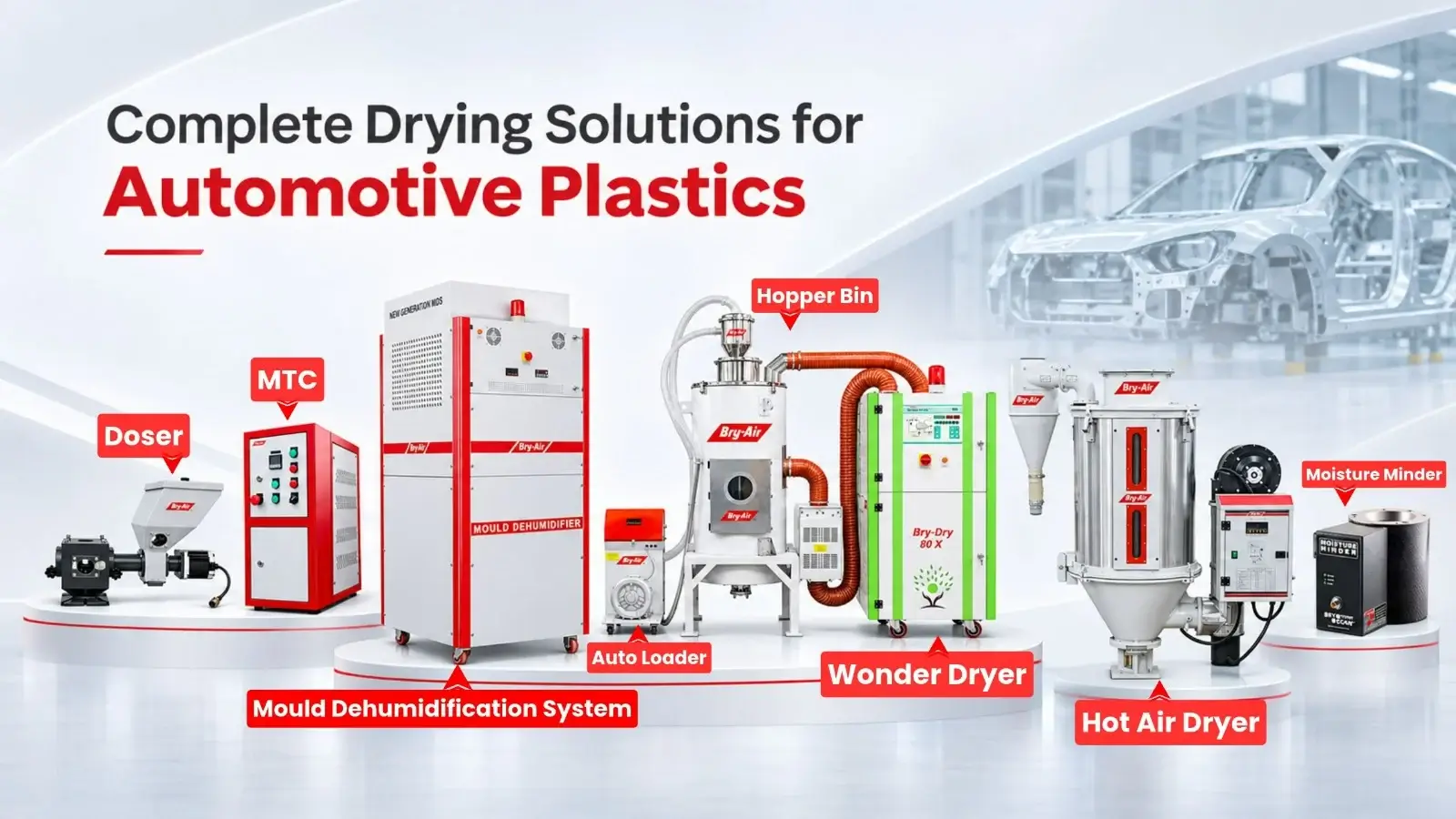
Bry-Air offers plastic drying systems designed for different resin types and production requirements.
Wonder Dryer is a waterless desiccant rotor dryer designed for hygroscopic resin applications. It can provide a dew point of −40°C or lower under specified operating conditions and does not require a dedicated chiller or chilled-water infrastructure. Its waterless design can help reduce utility dependence and simplify installation.
Nano Dryer is a compact drying option for applications involving moisture-sensitive engineering plastics and lower material throughputs. Bry-Air specifies a capacity of approximately 6–12 kg/hr for this range, making it relevant to suitable low-throughput and specialized moulding applications.
HAD Series Hot-Air Dryers are intended for non-hygroscopic resins and provide a different drying approach where deep dehumidification is not required.
The selection should be based on the resin grade, required moisture content, machine consumption, production schedule and available installation space. Energy savings and production improvements should be assessed against the existing setup rather than assumed to be identical for every plant.
What Should Automotive Manufacturers Evaluate Before Investing in a Plastic Dryer?
Production, process, quality and procurement teams should consider several factors before selecting a system.
- Material compatibility: Can the dryer meet the recommended drying conditions for the exact resin grades being processed?
- Production throughput: Is the dryer sized for actual resin consumption and the required residence time?
- Quality requirements: How will moisture-related defects and final moisture content be measured?
- Process stability: Can the system maintain consistent drying conditions across shifts and material changes?
- Energy consumption: What is the energy cost per kilogram of material dried?
- Maintenance and reliability: What servicing, spare parts and technical support will be required?
- Total cost of ownership: How do equipment cost, utilities, maintenance, production losses and service requirements compare over the equipment’s operating life?
A well-selected drying system should support both material quality and the manufacturer’s operational and financial objectives.
Conclusion
Plastic drying is an important process-control step in automotive manufacturing, particularly for components made from moisture-sensitive engineering plastics such as ABS, nylon, polycarbonate and PBT.
By conditioning resin before injection moulding, manufacturers can reduce the risk of hydrolytic degradation, minimize moisture-related defects and support repeatable component quality.
Bry-Air’s Wonder Dryer and Nano Dryer provide desiccant-based options for suitable hygroscopic resins, while the HAD Series addresses applications involving non-hygroscopic materials.
For automotive manufacturers, the objective is to match the drying technology to the resin, maintain the required moisture level and achieve consistent production without unnecessary energy and operating costs.
FAQs
Q1. Why does plastic need drying in automotive manufacturing?
Many engineering plastics soak up moisture, and melting damp resin leads to defects and weaker parts. Automotive plastic drying removes that moisture first, so components come out consistent from one batch to the next.
Q2. What defects can moisture cause in moulded parts?
Typical moisture-related moulding defects include silver streaks, bubbles, voids and reduced strength. Contamination or wrong machine settings can leave similar marks, so it’s worth checking those as well.
Q3. Which automotive plastics need to be dried before moulding?
Hygroscopic materials do. That includes nylon drying for injection moulding, ABS drying, polycarbonate drying and PBT drying, with exact needs depending on the grade. PE and PP usually need only light surface-moisture removal.
Q4. When should I use a desiccant dryer instead of a hot-air dryer for automotive plastic?
Use a desiccant-type plastic dryer for moisture-sensitive automotive plastic resins that require very dry air. A hot-air dryer is sufficient for non-hygroscopic resins like PE and PP, where only surface moisture needs to be removed.
Q5. How do I know the resin is dried properly?
Follow the resin supplier’s recommended temperature, time, dew point and airflow. Then check the moisture level of the pellets themselves, because the dryer display alone doesn’t confirm it.
Recent Posts