Polyethylene terephthalate (PET) is widely used in beverage bottles, food containers, pharmaceutical packaging and other moulded products because of its transparency, strength, lightweight properties and suitability for recyclable packaging applications. However, achieving consistent product quality starts well before the material enters the injection moulding machine.
PET resin drying is a critical process step because moisture in the resin can cause hydrolytic degradation during melt processing. This can reduce the polymer’s intrinsic viscosity (IV), compromise mechanical properties and contribute to quality issues in finished products.
For PET preform manufacturers, packaging converters and recycled PET processors, selecting the right drying system helps maintain resin quality, stabilize processing conditions and control operating costs.
Why Does PET Resin Need Drying Before Processing?
PET is a hygroscopic polymer, which means it absorbs moisture from its surroundings. Moisture can penetrate the resin rather than remaining only on the pellet surface, making ordinary hot-air treatment insufficient for many PET processing applications.
When moisture-containing PET is heated to its processing temperature, water reacts with the polymer chains. This reaction, known as hydrolysis, breaks down the polymer structure and can reduce molecular weight and intrinsic viscosity.
The effects can extend beyond the injection moulding stage, influencing the mechanical performance and appearance of the final product.
PET resin drying helps remove absorbed moisture before melting, reducing the risk of degradation and supporting consistent processing.
What Happens When PET Resin Is Not Dried Properly?
Inadequate drying can affect both the production process and the finished product. Common consequences include:
- Intrinsic viscosity (IV) loss: Hydrolysis can reduce molecular weight and compromise the mechanical properties required for the intended application.
- Reduced strength: Degraded PET may not deliver the expected mechanical performance.
- Haze and reduced clarity: Processing conditions and material degradation can contribute to visual inconsistencies in transparent packaging.
- Bubbles and surface defects: Residual moisture can contribute to processing defects, although their causes should be confirmed through troubleshooting.
- Inconsistent production: Variations in incoming moisture and drying performance can make process conditions less repeatable.
- Higher rejection and reprocessing: Quality problems can increase material waste, inspection requirements and production costs.
Not every defect originates from moisture. Resin quality, contamination, melt temperature, residence time, moulding conditions and blow-moulding parameters must also be evaluated.
Key PET Drying Applications
1. PET Preform Manufacturing
PET preforms are generally produced through injection moulding and subsequently converted into bottles using stretch blow moulding.
Because preforms form the foundation of the finished bottle, resin quality must be maintained before injection. Effective PET preform drying helps reduce hydrolytic degradation and supports consistent mould filling, transparency and mechanical performance.
For high-volume preform manufacturers, consistent drying conditions are especially important when multiple injection moulding machines operate continuously.
2. PET Bottle and Container Production
PET is commonly used for water bottles, beverage containers, edible oil packaging and food containers.
The resin must be adequately dried before injection moulding to support the required material properties. Insufficient drying can contribute to IV loss, which may affect the strength and performance of the finished container.
Drying is one part of the quality-control process. Bottle performance also depends on preform design, resin grade, injection moulding, reheating and stretch blow-moulding parameters.
3. PET Injection-Moulded Parts
PET is also used in selected industrial, electrical and consumer-product components.
In these applications, appropriate drying helps minimize moisture-related degradation and maintain consistent mechanical properties. Drying requirements depend on the specific PET grade, part design and processing conditions.
4. Recycled PET (rPET) Processing
Recycled PET is increasingly used in packaging and other applications where recycled material is suitable for the intended product.
However, recycled feedstock can vary in moisture content, contamination, intrinsic viscosity and previous thermal history. Washing and handling can also introduce additional surface moisture.
rPET drying must therefore be matched to the material’s condition, grade and intended application. Processors should verify incoming material quality and establish appropriate drying parameters rather than applying one fixed profile to every recycled PET stream.
Where food-contact packaging is involved, material suitability and applicable regulatory requirements must also be addressed separately from drying performance.
What Are the Correct PET Drying Parameters?
PET drying requires control over several interacting parameters. Temperature alone does not determine whether the resin is adequately dried.
| Parameter | What manufacturers need to control |
| Drying temperature | Follow the PET resin supplier’s recommended temperature range and account for the grade and equipment design. |
| Drying time | Allow sufficient residence time for moisture to diffuse out of the pellets. |
| Dew point | Maintain sufficiently dry process air to support moisture removal throughout the drying cycle. |
| Airflow | Provide uniform airflow through the resin bed to avoid uneven drying. |
| Final moisture content | Verify that the resin meets the supplier’s recommended moisture specification before processing. |
| Material handling | Prevent dried resin from reabsorbing moisture during storage and transfer. |
PET drying temperatures are often in the range of approximately 160–180°C, with drying times commonly around four to six hours in conventional applications. These are indicative ranges, not universal settings. Some resin grades and systems require different conditions.
Similarly, a dew point of −40°C or lower is commonly associated with desiccant drying for moisture-sensitive resins. The required drying-air dew point and final resin moisture content should be established using the resin manufacturer’s specifications and validated process conditions.
For PET, moisture targets may be expressed in parts per million (ppm). The appropriate target varies by grade and application, so processors should not rely on a single moisture limit for every PET resin.
How Does a PET Dehumidifying Dryer Work?
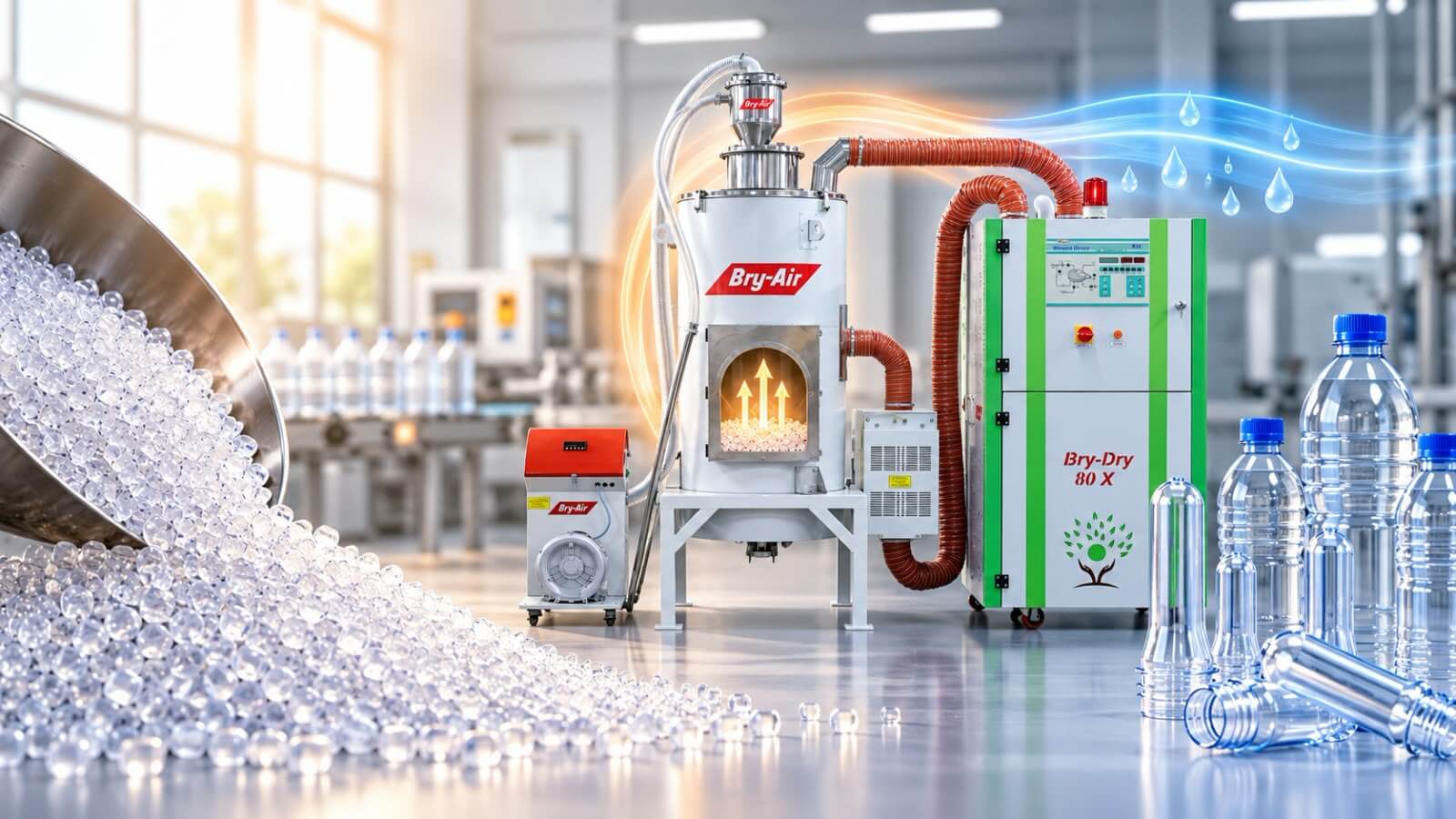
Industrial PET drying systems commonly use desiccant-based dehumidification.
A desiccant is a moisture-adsorbing material that removes water vapour from process air. The resulting dry air passes through the resin hopper, allowing moisture within the PET pellets to migrate into the air stream.
A typical drying process involves:
- Air dehumidification: The drying system removes moisture from the process air.
- Resin heating: Heated, dry air passes through the PET pellets.
- Moisture removal: Moisture diffuses from the pellets into the dry air and is carried away.
- Desiccant regeneration: The system regenerates the desiccant so it can continue removing moisture.
- Moisture verification: The resin is checked against the required moisture specification before processing.
The effectiveness of the process depends on maintaining suitable temperature, airflow, residence time and drying-air conditions.
Benefits of Using an Industrial PET Dryer
A correctly selected and operated PET dryer can help manufacturers improve process consistency and reduce avoidable losses.
Improved resin protection: Adequate drying reduces the risk of hydrolytic degradation during melt processing.
Consistent product quality: Stable drying conditions support repeatable preform and container production.
Lower moisture-related rejection: Controlling resin moisture can help reduce defects associated with inadequate drying.
Better process stability: Consistent material conditioning helps reduce moisture-related variation between production runs.
Improved energy management: Selecting an appropriately sized dryer and optimizing its operating conditions can reduce unnecessary energy consumption.
More reliable rPET processing: Appropriate drying and moisture verification help manage the variability associated with recycled feedstock.
These outcomes depend on correct equipment selection, maintenance, process control and the quality of the incoming material.
Waterless PET Drying: Reducing Utility Dependence
For PET processors, drying performance is only one consideration. Energy consumption, installation requirements and ongoing maintenance also affect the cost of production.
Conventional drying installations may rely on chilled-water systems and associated equipment, depending on their design. These utilities can add electrical load, piping, maintenance requirements and installation complexity.
Bry-Air’s Wonder Dryer uses desiccant rotor technology and is designed to operate without a chiller or chilled-water infrastructure. According to Bry-Air’s product specifications, it can deliver a dew point of −40°C or lower under specified operating conditions, including at a return-air temperature of up to 80°C at the desiccant rotor inlet.
The waterless design eliminates the need for a dedicated chiller, cooling tower and chilled-water circulation for the dryer, helping simplify plant utilities.
Bry-Air positions Wonder Dryer as an energy-efficient alternative, with potential energy savings of up to 40%. Actual savings depend on the existing installation, operating conditions, resin throughput and the equipment being replaced.
For PET preform and container manufacturers, the relevant evaluation criteria include:
- Ability to achieve the required drying-air dew point.
- Consistency of resin moisture at the machine inlet.
- Dryer capacity relative to production throughput.
- Energy consumption per kilogram of PET processed.
- Installation and utility requirements.
- Maintenance, service support and total cost of ownership.
The most appropriate system is one that consistently meets the resin’s drying requirements while fitting the plant’s production and operating-cost objectives.
How to Choose the Right PET Drying System
Before selecting an industrial PET dryer, manufacturers should evaluate the following:
Resin and application: Identify whether the material is virgin PET, recycled PET or a specific modified grade, and establish its processing requirements.
Production capacity: Match the drying system to actual resin consumption, machine output and the required residence time.
Moisture specifications: Define the acceptable moisture level before processing and establish a reliable verification method.
Airflow and dew point: Confirm that the system can maintain the necessary drying-air conditions at the required throughput.
Energy and utilities: Evaluate total system power, water consumption, auxiliary equipment and maintenance costs.
Process monitoring: Consider how resin moisture, drying-air conditions and operating parameters will be checked and recorded.
A dryer should be evaluated as part of the complete resin-handling process, including conveying, storage and transfer to the injection moulding machine.
Conclusion
PET resin drying is an essential process-control step in preform, bottle, container and moulded-part manufacturing. By removing absorbed moisture before melt processing, manufacturers can reduce the risk of hydrolytic degradation, protect intrinsic viscosity and support consistent product quality.
As production volumes increase and recycled PET becomes more important, processors need drying systems that combine appropriate moisture removal with reliable operation and efficient energy use.
Bry-Air’s Wonder Dryer offers a waterless desiccant drying option for suitable PET applications, eliminating the need for a dedicated chiller and associated chilled-water infrastructure.
The objective is not simply to dry PET resin. It is to maintain the required material properties, achieve repeatable production quality and control the total cost of drying.
FAQs
1. Why does PET need drying before processing?
PET is a hygroscopic polymer, so it absorbs moisture inside the pellet, not just on the surface. When damp resin is heated, the water triggers hydrolysis, which breaks the polymer chains and lowers the intrinsic viscosity (IV). PET resin drying removes this moisture before melting and protects the strength and clarity of the finished product.
2. What are the right PET drying parameters?
Several settings work together: drying temperature, drying time, dew point, airflow and final moisture content, usually measured in ppm.
3. How does a PET dehumidifying dryer work?
A PET dehumidifying dryer uses a desiccant to pull water vapour out of the process air. This dry, heated air flows through the resin hopper, and moisture moves from the pellets into the air stream. The system then regenerates the desiccant so it can keep working, and the resin is checked against its moisture specification before processing.
4. What is a waterless PET dryer, and what are its benefits?
A waterless PET dryer removes moisture without a dedicated chiller, cooling tower or chilled-water circulation. Bry-Air’s Wonder Dryer uses desiccant rotor technology and is designed to deliver a dew point of −40°C or lower under specified operating conditions.
This simplifies plant utilities, and Bry-Air cites potential energy savings of up to 40%, though actual savings depend on the existing setup and throughput.
5. How do I choose the right industrial PET dryer?
Match the dryer to your production capacity and resin type (virgin, rPET or modified grade). Then check that it can hold the required dew point and moisture specification at your throughput.
Recent Posts