Water Is the Next Strategic Resource
For decades, business continuity planning revolved around energy security, supply chains, and workforce availability. Today, another critical resource has moved to the forefront of boardroom discussions—water.
Across the globe, businesses are facing increasing pressure from declining groundwater levels, erratic rainfall patterns, climate change, aging water infrastructure, and rising industrial demand. What was once considered an inexpensive utility is rapidly becoming one of the biggest operational risks for industries worldwide.
The question is no longer “Will water shortages affect my business?” It is “When they do, will my business be ready?”
Water resilience is becoming a competitive advantage. Organizations that proactively diversify their water sources today will be better positioned to sustain operations, protect profitability, and meet future sustainability goals.
Understanding Water Stress
Water stress occurs when the demand for freshwater exceeds the available supply during a certain period or when poor water quality limits its use. Unlike temporary shortages, water stress is becoming a long-term challenge affecting industries, municipalities, agriculture, and commercial establishments.
According to global studies, billions of people already live in regions experiencing high water stress for at least part of every year. Rapid urbanization, industrial expansion, and changing climate patterns are accelerating this challenge.
For businesses, water stress translates into:
- Higher water procurement costs
- Production disruptions
- Increased dependence on tanker supplies
- Restrictions on groundwater extraction
- Regulatory compliance challenges
- Rising ESG expectations from investors and customers
Water has evolved from an operational utility into a strategic business asset.
Why Businesses Cannot Rely on Traditional Water Sources Alone
Most industries still depend primarily on one or more of the following:
- Municipal water supply
- Groundwater borewells
- Surface water
- Water tankers
- Bottled drinking water
Each of these sources comes with growing challenges.
Municipal supplies are increasingly stretched. Groundwater tables continue to decline. Tanker costs fluctuate dramatically during drought periods, while transporting bottled water significantly increases both operational expenses and environmental impact.
Businesses that rely on a single water source expose themselves to unnecessary operational risk.
The future belongs to organizations that develop water independence through diversified and resilient water strategies.
Building a Water Resilience Strategy
Forward-looking organizations are adopting a multi-layered approach to water security.
An effective strategy combines:
- Water conservation
- Water recycling and reuse
- Rainwater harvesting
- Smart water management systems
- Decentralized water generation
Instead of depending entirely on external infrastructure, businesses are increasingly investing in technologies that generate water where it is actually needed.
This shift is redefining industrial water management.
Atmospheric Water Generation: A New Source of Sustainable Water
One of the most promising innovations in sustainable water technology is the Atmospheric Water Generator (AWG).
The atmosphere continuously contains enormous quantities of water vapor through Earth’s natural hydrological cycle. Atmospheric Water Generators capture this moisture and convert it into clean drinking water.
Unlike groundwater extraction, atmospheric water generation does not deplete aquifers.
Unlike transported water, it eliminates complex logistics.
Unlike desalination, it does not depend on proximity to the sea.
It simply transforms the renewable moisture already present in the air into a dependable water source.
As businesses seek climate-resilient infrastructure, AWGs are emerging as an important component of future water security.
Why Desiccant-Based Atmospheric Water Generators Are Different
Many conventional Atmospheric Water Generators rely entirely on refrigeration-based cooling to condense moisture.
While effective under high humidity conditions, their performance often declines significantly when humidity levels fall.
This is where Bry-Air’s Air Water Generator offers a fundamentally different approach.
Drawing on more than 60 years of expertise in adsorption technology, Bry-Air uses a patented desiccant rotor to efficiently capture moisture before converting it into potable water. This adsorption-based process expands the operating range and enables dependable water generation even in environments where conventional systems become less effective.
Key Advantages of Bry-Air’s Desiccant AWG Technology
Reliable Operation in Low Humidity
One of the biggest limitations of conventional AWGs is their dependence on high relative humidity.
Bry-Air’s adsorption technology is specifically designed to recover atmospheric moisture efficiently, even under comparatively lower humidity conditions, making it suitable for a much wider range of climates.
Decentralized Water Independence
Imagine producing drinking water exactly where it is required.
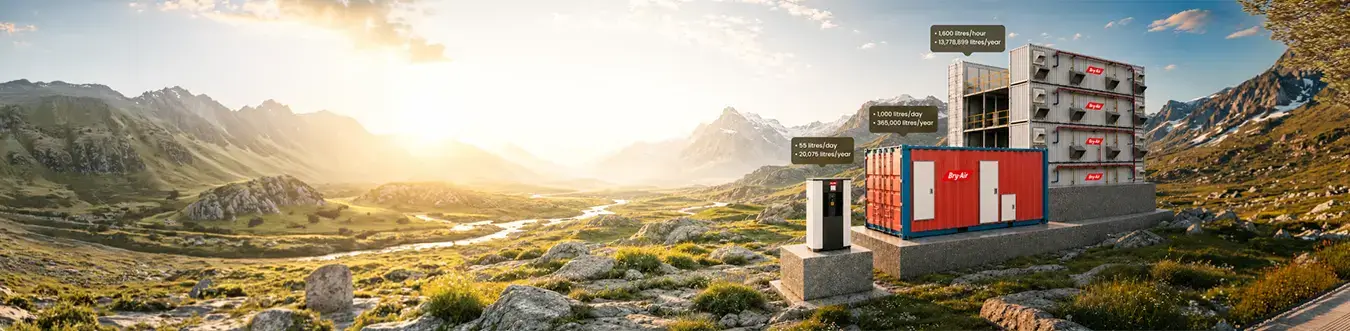
Whether at an industrial facility, remote mining operation, military installation, resort, or infrastructure project, decentralised water generation reduces dependence on external supply chains.
This enhances business continuity while reducing transportation costs and associated carbon emissions.
Scalable for Industrial Applications
Industrial water demand is rarely static.
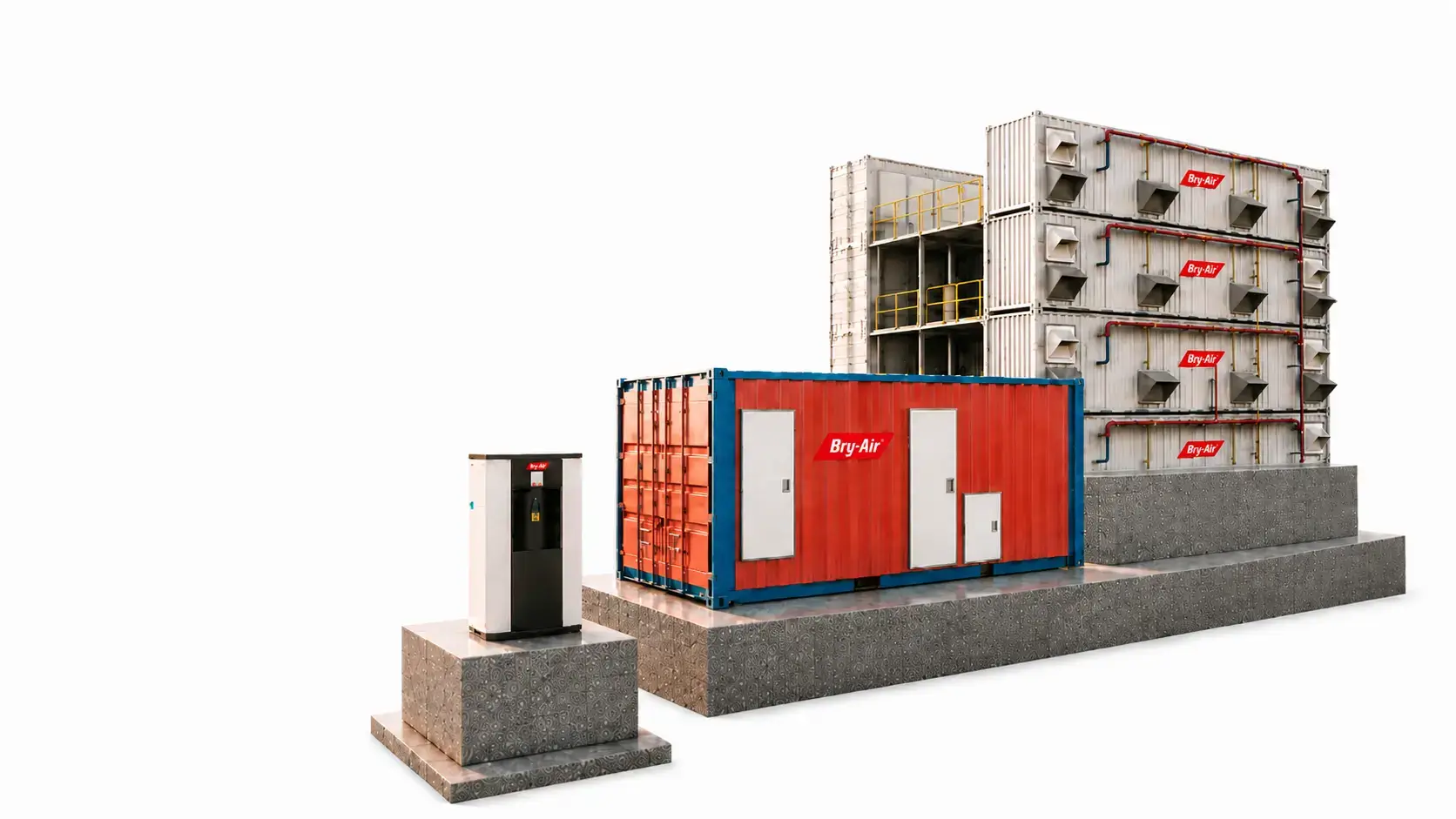
Bry-Air’s modular design allows organizations to scale production as demand grows, making the technology suitable for applications ranging from commercial buildings to large industrial facilities.
Sustainable Water Generation
Every litre generated from atmospheric moisture reduces pressure on conventional freshwater resources.
Businesses pursuing ESG goals and sustainability commitments can significantly strengthen their environmental initiatives by adopting renewable water from air technology.
Water produced from the atmosphere represents one more step toward a circular, resource-efficient future.
Industries That Can Benefit from Atmospheric Water Generation
As water stress increases, Atmospheric Water Generators are becoming valuable across numerous industries.
These include:
- Manufacturing
- Data Centres
- Pharmaceuticals
- Electronics Manufacturing
- Food & Beverage Processing
- Mining
- Oil & Gas
- Defence
- Smart Cities
- Hospitality & Resorts
- Greenhouses and Vertical Farming
- Disaster Relief Operations
- Remote Infrastructure Projects
Each of these sectors faces growing pressure to secure reliable water supplies while meeting sustainability objectives. Bry-Air’s modular AWG systems are designed to support a wide range of such applications.
Is Your Business Ready for Future Water Shortages?
Every business leader should ask:
- How dependent are we on municipal water?
- What happens if groundwater extraction is restricted?
- Can production continue during prolonged droughts?
- Are we prepared for increasing water costs?
- Could decentralized water generation improve our resilience?
- Does our sustainability strategy include long-term water security?
These questions are becoming increasingly important as climate risks reshape industrial planning.
The Future of Water Is Decentralized
Just as businesses invest in backup power systems to ensure uninterrupted operations, future-ready organizations will increasingly invest in backup and decentralised water generation systems.
Water generation is moving closer to the point of use.
This transition offers multiple benefits:
- Improved business continuity
- Lower transportation costs
- Reduced dependence on vulnerable infrastructure
- Greater resilience during emergencies
- Enhanced sustainability performance
Atmospheric Water Generation is expected to become an integral component of modern water infrastructure, especially in water-stressed regions.
Bry-Air: Engineering Water Independence
For over six decades, Bry-Air has been recognized globally for pioneering adsorption and dehumidification technologies.
Building on this legacy, Bry-Air’s Desiccant AWG combines proven engineering with advanced adsorption science to deliver reliable, scalable, and sustainable water solutions.
Designed for industrial applications and challenging climatic conditions, Bry-Air’s AWG systems help organizations move towards water independence, ensuring that clean drinking water is available where and when it is needed.
As businesses prepare for an increasingly water-constrained future, investing in resilient technologies today will define tomorrow’s operational success.
Final Thoughts
The world’s water challenges cannot be solved by relying solely on traditional sources.
Innovation, sustainability, and decentralized infrastructure will play a defining role in ensuring future water security.
Businesses that begin preparing today will not only reduce operational risks but also strengthen their competitiveness, improve ESG performance, and build long-term resilience.
The future belongs to organizations that are prepared—not just for energy security, but for water security.
Is your business ready?
FAQs – Bry-Air Atmospheric Water Generator
What is a Desiccant AWG?
A Desiccant AWG (Atmospheric Water Generator) uses adsorption technology to capture moisture from atmospheric air and convert it into usable drinking water. Unlike conventional systems that rely primarily on refrigeration, desiccant-based AWG technology is designed to support water generation across a broader range of humidity conditions.
How does atmospheric water generator work?
Atmospheric water generator uses a desiccant rotor to capture moisture from the air through adsorption. The captured moisture is then released during the regeneration process and subsequently condensed and collected as water, enabling continuous atmospheric water generation.
What is decentralised water generation?
Decentralised water generation means producing water at or close to the location where it is required rather than relying entirely on centralized water infrastructure. Atmospheric water generators can support this approach for industrial facilities, remote locations, infrastructure projects, resorts, and other applications.
How does water from air technology work?
Water from air technology captures naturally occurring moisture present in atmospheric air and converts it into water. Atmospheric Water Generators use moisture-capture and water-generation processes to provide an alternative source of water without depending exclusively on groundwater or transported water supplies.
What are the advantages of a Desiccant AWG over conventional AWGs?
A Desiccant AWG uses adsorption to capture atmospheric moisture, making the technology particularly relevant for environments where conventional refrigeration-based AWGs may become less effective as humidity decreases. This can provide greater flexibility for water generation across different climatic conditions.
Where can decentralised water generation be used?
Decentralised water generation can be useful in locations where conventional water infrastructure is limited, vulnerable, or expensive to access. Potential applications include manufacturing facilities, mining operations, defence installations, hospitality, remote infrastructure, disaster relief, and other water-stressed environments.
Is atmospheric water generator suitable for industrial applications?
Yes. Atmospheric water generator can be configured as part of scalable atmospheric water generation systems for industrial applications. Modular systems can help organizations generate water closer to the point of use and reduce dependence on external water transportation and supply infrastructure.
Can Water from air technology help businesses improve water resilience?
Yes. Water from air technology can form part of a broader water-resilience strategy by providing an additional, decentralized source of water. It can help businesses diversify their water sources and reduce dependence on conventional supplies, particularly in regions facing increasing water stress.
Recent Posts