Our Airgineers Can Help You Select The Right Product!
Contact Us
Our Airgineers Can Help You Select The Right Product!
Contact Us
Hygroscopic polymers absorb moisture into their core, introduced during processes such as cleaning and washing the granules, and pulled in by vapour pressure difference. Monsoon humidity and winter reverse osmosis add more moisture inside the granules.
Yes. Engineering polymers such as PET are also hygroscopic, so moisture can penetrate the core of the material. They need high concentrations of low dew point air to eliminate that moisture, which is why low dew point plastic drying matters.
If the moisture isn’t removed before the granules are converted into components, it can reduce the physical properties of the material and leave a poor surface finish. Effective polymer moisture removal prevents this.
Granules are brought into the molten phase by heat inside the screw barrel, and the polymer bonds are then in a vulnerable stage. Steam formed from moisture evaporation becomes integrated into the polymer structure and reduces its strength, so the moisture level should sit below its maximum permissible limit.
Bry-Air offers dryers tailored to Nylon/PA66, PC, TPU, TPE, PET, PBT, POM, ABS and Semicon. These serve applications such as packaging, sheets, automobile parts, electrical switchgear, white goods, medical items and cables, and effective PET nylon polymer drying is one common use.
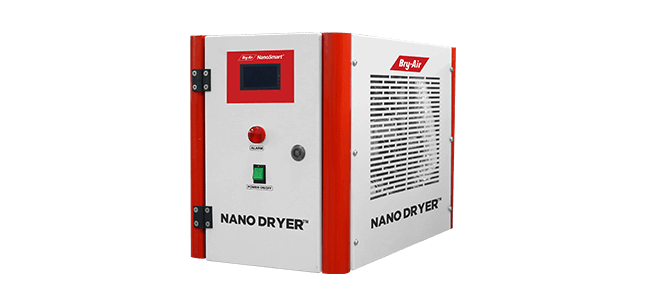
The Nano dryer delivers a (-) 40 °C dew point for small-quantity processors of special materials with low throughputs. It provides high precision output of 6-12 kg/hr and treats polymers in automobile, medical, electrical, mobile part, stationery and toy applications, which suits plastic granule drying at low volume.
Our Airgineers Can Help You Select The Right Product!
Contact Us
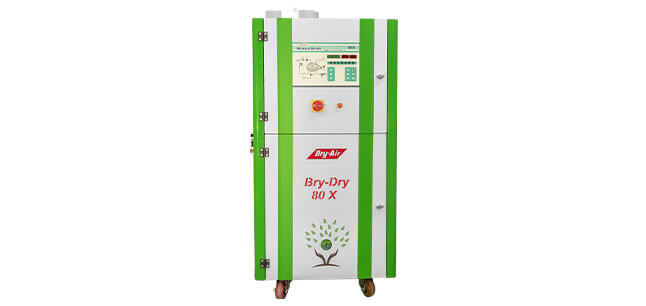
Cabinet-style dehumidifying waterless plastic dryer (ranging from 30 CMH to 3500 CMH)
 view more
Let's
Get In
Touch